|
|
|
Canistel
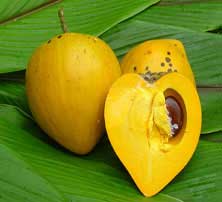
A Canistel fruit is a glowing yellow, waxy skinned fruit with a flesh that has the consistency of a hard-boiled egg yolk. Highly superior in the tropics, the canistel is seldom grown in the United States. Fruits can be highly variable in size and shape--ranging from round to pointed and ovaloid.
|
Canistel is colloquially called as the "eggfruit". When ripe, it is said to have a texture similar to that of a thoroughly cooked egg yolk. The meat of the fruit is sweet and edible raw. The exterior of a canistel fruit is a polished skin that, upon ripening, varies in yellow color and orange tones. Canistel fruit is soft, rather than hard, and it is not mostly juicy. Inside the fruit are a few large polished black or dark brown seeds. While canistel fruits are not available in most markets in North America, they are available in Florida.
Taste-The fruit has an orange to yellow thin skin, and the flesh is dry like a boiled egg yolk. They are usually eaten fresh,and generally used for cooking pies.They have an excellent taste in ice cream. In milk shakes they taste like eggnog. They are much related in taste to the Lucuma from Andean countries. It has a sweet taste and is a raw edible fruit.
Appearance
-The exterior of a canistel fruit is a polished skin that, upon ripening, varies in yellow color and orange tones. Canistel fruit is soft, rather than hard, and it is not mostly juicy.Inside the fruit are a few large polished black or dark brown seeds.
|
| |
|
Uses of Canistel Fruit |
Canistel fruits is a just like juicy fruit and it is very popular and tasty fruits in corresponding area's.
Some Floridia people were enjoy the fruit with salt, pepper and lime or lemon juice or mayonnaise, either fresh or after light baking for to taste. The pureed flesh can be used in custards or added to ice cream mix just before freezing. A rich milkshake, or "eggfruit nog", is made by mixture's of ripe canistel pulp, milk, sugar, vanilla, nutmeg or other seasoning in an electric mixer.
Good source of vitamin A and niacin, fair source of vitamin C, calcium iron and phosphorus. |
Canistel Tree
|
Canistel trees grow best in all tropical and warm of subtropical climates at altitudes below 4,500 ft,it requires periodic rain. Trees are also moderately cold tolerant, however young trees can be damaged or killed at temperatures of 29°F and mature trees at 23°F.Canistel trees can even survive and tolerate excessively wet or flooded conditions for several days; however crop production can be impacted.
- Planting the tree correctly is very important for successfully establishing growing and growing a strong, productive trees
-
Young Canistel trees need to be fertilized a every couple of months in the first year, starting with around 100 grams of fertilizer and increasing to around 500 grams per tree.
-
Periodic pruning of canistel trees can keep trees at a manageable height. Young newly planted canistel trees should be planted and left to grow during their first year so that they can establish themselves quickly. The following year in spring, trees should be trimmed back to encourage branching along the main trunk to encourage the formation of evenly spaced branches.
|
|
 |
Nutrition Information Of Canistel |
The fruit is Rich in niacin and carotene with a fair amount of vitamin C.Canistel fruit provides niacin, iron, protein and fiber. |
|
Health benefits of Canistel |
Like most fruits, canistel fruits are more rich in a number of nutrients especially vitamins. They are mainly rich in carotene and niacin.
100g of Canistel flesh contains about 140 calories, 1.7g protein, 0.1g of fat, 37g carbohydrates, 37mg phosphorus, 58mg Vitamin C.
A decoction of the mordant bark is taken as a febrifuge in Mexico and applied on skin eruptions in Cuba. A preparation of the seeds has been employed as a remedy for ulcers
.
In 1971, a pharmaceutical company in California was exploring a derivative of the seed of Pouteria sapota which seemed to be active against seborrheic dermatitis of the scalp. |
Canistel Nutrition facts |
Overview of vitamin and mineral content including nutrition charts of the Canistel fruits.
| Nutritive value per 100 g of Canistel |
| Principle |
Nutritive value |
| Protein |
1.68 g |
| Moisture |
60.0 mg |
| Thiamin |
0.17mg |
| Fat |
0.13 mg |
| Carbohydrates |
39.69 mg |
| Phosphorus |
37.3 mg |
| Calcium |
26.5 mg |
| Iron |
0.92 mg |
| Niacin |
3.72 mg |
|
|
|  |
Canistel Recipe
|
CREME DE CANISTEL ICE CREAM |
Ingredients:
- 1 cup canistel pulp
- 1/4 cup blanched almonds
- 2 cups milk
- 2/3 cup heavy cream
- 3 egg yolks
- 1/2 cup sugar.
Method:
Add the canistel, milk and heavy cream to a bowl and mix thoroughly together to a smooth mixture.
In separate a bowl, mix the egg yolks and sugar until light and fluffy. Add the Canistel mixture and mix well with wooden spoon. Return the mixture to the saucepan. Stir over medium-low heat until the custard thickens and coats the back of a spoon, do not boil.
Strain custard into a clean bowl and refrigerate until cold. Process custard in ice cream maker according to manufacturer's instruction. Transfer to covered container and freeze until firm. |
|
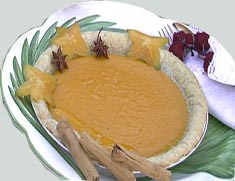
CANISTEL PIE |
Ingredients:
- 1 1/3 cups mashed canistel
- 1 teaspoon lime juice
- 2/3 cup brown sugar
- 2 beaten eggs
- 1/2 teaspoon salt
- 1 1/4 cups low-fat evaporated milk
- 1/4 teaspoon nutmeg
- 1-9 inch pie crust
- 1 teaspoon cinnamon
Method:
Mix dry ingredients first, add remaining ingredients, except pie shell. Pour into unbaked pie shell and bake at 230 degrees C for 10 minutes. Reduce heat to 120 degrees C and continue baking about 50 more minutes. Serve warm or chilled, with whipped cream. |
|
|
|
|
|
|
|
|
Special fruits for this week
|
 |
Banana
Store ripe bananas outside for 3 days or in the refrigerator for several days. It is rich in carbohydrates, low in fat, high in potassium and Vitamin C. (Read more) |
|
 |
Grapes
Grapes can be eaten raw or they can be used for making jam, juice, jelly, vinegar, wine, grape seed extracts, raisins, molasses and grape seed oil. (Read more)
|
|
 |
Mandarin Orange
Mandarin oranges are mostly available during December and January. Good source of Vitamin C and Copper. (Read more) |
|
|
|
|
|
|
|
| |
|