|
|
|
Rambutan
The rambutan, a botanically named as Nephelium lappaceum, is a fruit measured that it ia an Exotic fruits that are cuiltivated mostly in Malaysia and Thailand. To people of Malaysia, Thailand, the Phillippines, Vietnam, Borneo, and other countries of this region, the rambutan is a comparatively common fruit the same way an apple is also a common to many people in cooler climates. This can change for the rambutan over time as availability and allocation improve.
|
|
|
|
 |
RAMBUTAN FRUIT |
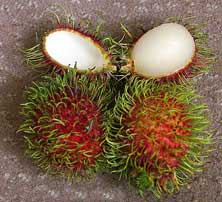
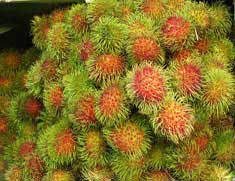
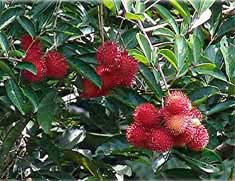
Appearance-Rambutan fruit is naturally red in color but they some times seems like yellow or orange. 'Rambut' is a Hairs is a word from Malay, hence it gets its name because of the Thorn like appearance of its fruits.The shape of Rambutan fruit is round or oval and it is upto three to six to four cm in dimension. Rambutan is borne in clusters.Its leather like skin has flexible thorns.It having brownish seed with two to three cm in size and is basally scarred. It is soft and crusty.
Taste-A good rambutan to having a firm and juicy flesh. It has a sweat taste that most appearance the tastes of Lychee Fruits.The tree will actually look like a enlarged Chirstmas tree.A rambutan is best within mid-season somewhere around June-August as they seem to be most sweet, and large.. It is more sweet than sour. When it get ripe the flesh separates easily from the seed. But it not quite ripe the flesh sticks to the rambutan seed and the taste is a little sour overall, still not a bad taste though.
|
Look- Even though the raw seeds are poisonous, they may be eaten after cooking. .Complete ripe fruits are mostly ugly brown in Nature
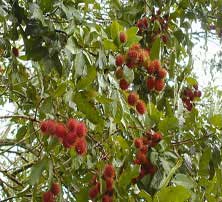
The Rambutan tree grows upto 10 to 20 m in height. Its alternate leaves are 10 to 30 cm in length and have three to eleven leaflets, each and every with an entire margin have a special structure.Small Flowers with leaf petal which are about 2 1/2 to 5 mm in size are in disk-shape and they have bloomed cluster wise. |
|
Uses of Rambutan Fruit |
Rambutan is a juicy fruit and it is very popular and tasty fruit in many countries. Seed oil from the Rambutan is formed and in use to manufacture candles and soap. Although Rambutan trees are cut down not often. This wood is also used in the construction industry. Rambutan fruit is said to heal dysentery and diarrhea effectively. This fruit leaves are also used as cataplasm to cure headaches. In Malaysia, Rambutan fruit skin is used to prepare native medicines. Further, Rambutan trees roots are boiled and used as a medication to cure fever.
Cultivated for its fresh fruit, but also container in syrup, cooked for stewed fruit and jams. The colorful fruits are regularly used in displays with flower and fruit arrangements .The leaves are used as poulticing and the bark for an astringent for tongue diseases. Young shoots are used to produce a green color on silk that is first dyed yellow with turmeric. The fruit dye is one of the ingredients to dye silk a black color. The seeds are edible when roasted, they are bitter and said to be narcotic. |
Rambutan Tree
|
 |
The tree is called as in many names, the primary named as Rambutan. Some others, but there are several different dialect names to the small native communities that surround Southeast Asia.
- Ramboutan or ramboutanier in French
- Ramboetan in Dutch
- Ramboostan in India
- Shao tzu in Chinese
- Chom chom or vai thieu in Vietnam
- Ser mon, or chle sao mao to Kampucheans
The rambutan tree is an evergreen that grows always in height of 10-20m. The leaves alternate between pinnate and leaflets it can have a small flowers in brances. The male trees can be, that only produce staminate flowers, female, that produce flowers that function as females or the hermaphroditic variety that produce mostly female flowers and a small percentage of male flowers. |
|
 |
Rambutan Varieties
Click on the below Rambutan you wish to find about |
|
|
The various Rambutan are distinguished as botanical species rather than as cultivars. The following are those most utilized for food:
|
 |
A dark-red fruits having a board topped tree structure, uncrowded spines (1.5 cm) in long, and grayish-white, tough, subacid flesh (0.5 cm) in thick, its so difficult to separate from the seed and often takes pieces of the testa with it. Ships well over long distances.
It will also cultivated in India.decorated with swirling prolutorasantimetrovymi spines. His sticky sour pulp, rather tightly attached to the seed. This variety is very tolerant of transport over long distances. |
|
| |
 |
Fruits are dark-red with spines to 2 cm in long. Tree have a single open crown and long flexible branches. Various insects are taken out from tree prone as using this tree prone. In the Philippines where it has an averaged 16 lbs/.
'Seematjan besar' with small fruit, thin rind, very sweet, fairly juicy flesh to which the coarse, fibrous testa tightly adheres; 2) 'Seematjan ketjil' (or 'Koombang')-the fruit has soft, tough, and less sweet flesh to which the seed coat does not tightly . |
|  |
|
| |
 |
Rambutan tree having a low growing with drooping crown. Fruit nearly ovoid, about in 4 cm in long and 3 cm in wide. The dark wine-red with slender, flexible spines about 1 cm in long.
Flesh clings firmly to the seed.'Seenjonja' with an average production of 41 kg considerably in Philippine Agriculturist |
|  |
|
| |
 |
At ambient condition was reduced to 42 in Weight loss in rambutan which could be as high like 32% after five days exposure and six times by pack in sealed and perforated polyethylene bags, respectively.
"Senjonja" has a larger surface spot lost weight faster than "Maharlika". But Maharlika Fruits kept in sealed bags developed large faster than perforated bags or at ambient conditions. After two days of storage in sealed bags, browning of the fruits reached up to 75%. |
|
| |
 |
A Fruit having a flattened ellipsoid shape with about 5 cm in long and 4 cm in wide and ita nature always like slim spines wit 1 cm in long. Tree structure is broad- topped.
Coat is thin, elastic, tough. Fruits are yellowish white and sweet which are separated from the seed. For shipment its stand for long distances. |
|
| |
 |
These are large in size, sweet in nature. The flesh is like a salmon-colored, with a sweet, berry-like flavor. They are great for eating out of hand, or for making fruit salads or smoothies.
Markets often sell them while they are still hard and undermature, so you need to set them on the counter for a few days until they yield when gently squeezed. |
|
| |
 |
This tree has a Fast growing but fruits are tasteless. Fruits faintly flattened, about 5 cm in long, 4 cm in wide.
Spines of the fruits are thick and short. Flesh is dull and dry, grayish-white, clings to the test a which separates readily from the seed. |
|  |
|
 |
Rambutan Nutrition Information |
 |
Current Facts:
Fruits are demands from Asian migrant fans have an increased the import of rare fruit into the Europe, the Middle East and North America. Usual suppliers are Malaysia, Thailand and Indonesia but today the Honduras and Australia are greatly entering the raging rambutan fruits in market. An anticipated worldwide demand is the result of improved handling of post harvest fruits, increased production and faster long-distance transporting of this delicate fruit. Thailand exports the most can rambutan fruit.While Malaysia is the largest exporter of fresh rambutan fruit in our local area.
Nutritional Value:
A basis of vitamin C and calcium, rambutan fruit provides a niacin, iron, protein and fiber. There are 59 calories from average fruits. To avoid cancer diseases ,continuesly five days eating of rambutan fruits.. A recent study found eating nine or ten daily of fruits and vegetables of rambutan family, were effective in lowering blood pressure.200 Calories |
|
Health benefits of Rambutan |
Rambutan fruit contains carbohydrate, protein, fat, phosphorus, iron, calcium and vitamin C. Coat tannin of fruit and Leaves contain saponin. The seeds always containing fat and polifenol. Skin and stem contains tannin, saponin, flavonida, pectic substances, and iron.
There are usually a light brown seeds are high in some Fats and oils valuable to industry, and is used in cooking and the manufacture of soap. Rambutans roots, always make use of bark, and leaves have various uses in the production of dyes and drugs.
Part of this plant can be used as a medicinal fruit and have benefits for health such as
- Reduce Body Fat
- Make skin softer face
- Hair care
- Treat dysentery
- Treat diabetes
|
Rambutan Nutrition facts |
Fruit comparison tables. Overview of vitamin and mineral content including nutrition charts of the Rambutan fruits.
| Nutritive value per 100 g of Rambutan |
| Principle |
Nutritive value |
| Protein |
1.0 g |
| Cholesterol |
0.0 mg |
| Thiamin |
0.01mg |
| Vitamin C |
7.4 mg |
| Sodium |
16.5 mg |
| Potassium |
63.0 mg |
| Calcium |
33.0 mg |
| Vitamin A |
4.5 IU |
| Iron |
0.5 mg |
|
|
|  |
Rambutan Recipe
|
1. Savory Stuffed Rambutans
|
- 2 cloves garlic, firmed.
- 2 teaspoons (approx) firmed coriander roots
- 2 tablespoons fresh coriander leaves (or sage) vegetable oil
- 4 tablespoons ground roasted peanuts
- 4 teaspoons soy sauce.
- 4 tablespoons palm sugar .
- 1 chopped de-seeded chili pepper
- 2 cans rambutans, exhausted.
Drop the edible oil to fry the crushed garlic and coriander roots. When garlic is become golden in color, add all other ingredients except rambutans into the mixtures . Cook well and stir until the mixture is browned, and fairly dry. Add rambutans into the ingredients. Cook and mix well for about 2 minutes. Serve as an entree, or as a main route with rice...
|
2.Waldorf salad with grilled goats' cheese |
A very simple, sophisticated use for the tropical fruit also known as 'chocolate pudding fruit'.
For the dressing:
- 4 teaspoon cranberry sauce
- 3 teaspoon extra virgin olive oil
- 6 teaspoon apple juice
- 2 teaspoon red wine vinegar
- 1 teaspoon wholegrain mustard
Method:1. For the dressing :. Keep in a large basin and whip together all the dressing ingredients. Transfer half of the dressing ingredients to another bowl for quick procress.
For the salad:
- 4 red dessert apples
- 4 sticks celery, plus leaves to garnish
- 3 logs goats cheese
- 50g walnut pieces
- 100g rocket
Method:2.For the salad: Cut into small pieces of apples and celery for a needs. Place it in one of the bowls with the dressing and mix together so that all the pieces are covered.
3. Preheat the grill to a high location. Cut each cheese into half and place it in , cut-side up under the grill. Grill the cheeses until they become golden brown and they get melt.
4. While the cheese is grilling, flip the salad leaves in the remaining dressing and arrange among 6 serving plates. Mass the apples and celery in the Middle of the salad leaves and spread the walnut pieces on top of the salad
5. Place each cheese on top of the salad or you could arrange in smaller slices and serve immediately.
|
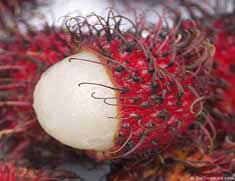
| Open the rambutan by removing part of the skin in any one of several ways |
|
|
|
|
|
|
|
|
Special fruits for this week
|
|
|
|
|
|
|
|
|
|
|
|
|
|
|
| |
|