






 Full List of Fruits Kumquat Fruit
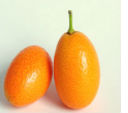

Kumquat is also known as Kin Kan belongs to the native China and Indochina.This Fruit is rich in Dietary fiber and Vitamin C. Kumquats are small, oval citrus fruits. They are usually between one to two inches long and have leathery orange or yellow skin. The fruit has a sweet outer skin and a tart inner flesh.
Kumquat leaves are simple, evergreen leaves that are arranged alternately along the stem. They are 1 to 3 inches long, finely toothed, dark green on the top of the leaf and lighter on the underside. The trees are planted in the yard or in larger pots. Temperatures for kumquat Fruit are as low as 28 degrees. It requires about the same care as other citrus fruits.
The mature kumquat tree bears hundreds of olive sized orange color fruits in winter. This fruit resembles tiny orange with juicy segments firmly adherent each other and with the rind. The pulp contains 1-2 seeds in center. The seeds are bitter in taste as in oranges and generally spit out.

The various kumquats are distinguished as botanical species rather than as cultivars. The following are those most utilized for food:

- Hong Kong varieties are also called as chin chü, shan chin kan, and chin tou that belongs to the native Hong Kong and adjacent hilly and mountainous regions of Kwantung and Chekiang Provinces of China.
- It is around1.6-2 cm wide and the peel is orange in color or scarlet when mature.
- The pulp of this fruit contains only 3 or 4 small segments.
- Chinese people flock to the foothills to collect these fruits .
- In the western world, the thorny shrub is grown only as an ornamental pot plant.

- 'Marumi'or Round Kumquat are accounted by the first time in 1784 and introduced into Florida by Glen St from Japan .
- The ‘Marumi’ is also known as ‘Calamondin’ kumquat that are flattened, like mini mandarins.
- The fruit of this plant is round in shape, slightly oblate or obovate to 1 1/4 in (3.2 cm).
- It is long and the peel is golden-yellow in color with smooth texture containing larger oil glands
- Marumi trees fruit several times a year, with the main crop in winter.
- The bushes are dense and they are the best looking of all citrus in containers and reaches 9 ft (2.75 m)

- 'Meiwa' or Large Round are also called as ninpo or neiha kinkan
- This fruit is a hybrid between 'Nagami' and 'Marumi' was introduced from Japan by the U. S Department of Agriculture in1910 -1912.
- It is short-oblong to round, about 1 1/2 in (4 cm) wide and the peel is orange-yellow in color.
- The pulp usually have 7 segments, relatively sweet or subacid and are often seedless or with few seeds.
- The tree is dwarf, frequently thornless or having short, stout spines.
- The leaves of this tree are very thick and rigid and partly folded lengthwise and are pitted with numerous dark-green oil glands.
- This Fruit was discovered on a Nagami seedling by George Otto Nordmann in 1965 .
- This fruit is similar to Nagami, slightly differ in shape with lighter skin and contains no seeds.
- This fruit is medium in size with teardrop shape, and hence it is tapered towards at the end of the stem.
- This fruit is rind thick, yellow-orange in color
- The pulp of this fruit is tart and are fairly juicy.
- The flavor of this fruit is similar to Nagami and it is seedless fruit.
- This fruit commercially grown in very small quantities in California.

- 'Nagami', or Oval Kumquat plants are introduced from China to London in 1846 by Robert Fortune, plant explorer for the Royal Horticultural Society was reported in North America in 1850.
- This plant is obovate or oblong up to 1 3/4 in (4.5 cm) long and 1 3/16 in (3 cm) wide .
- The pulp of this fruit can be divided into 4 or 5 segments, contains 2 to 5 seeds.
- The Nagami Kumquat fruit stays fresh on the tree longer.
- This trees can withstand temperatures as low as 28F which make it easily grown in areas that are too cold for most varieties of citrus.
Kumquats are low in calories. 100 g of fresh fruit contain only 71 calories. They are incredibly rich sources of health benefiting dietary fiber.The minerals, vitamins, and anti-oxidants present in this fruit contribute immense benefits to our health and wellness.
Kumquats can be eaten along with the peel contains unique feature that differentiates them from other citrus family fruits. The peel is rich in essential oils, anti-oxidants, and fiber. 100 g kumquats provide 17% recommended levels of of tannins, pectin, hemi-cellulose, and other non-starch polysaccharides.
Fresh fruits contain adequate levels of anti-oxidant vitamins such as vitamin A, C and E. These phyto-chemical compounds in kumquat fruit helps scavenge harmful oxygen derived free radicals from the body and thereby protect us from cancers, diabetes, degenerative diseases and infections.
kumquats also very rich in vitamin C. Vitamin-C is one of powerful natural anti-oxidant which has many essential biological roles like collagen synthesis and wound healing; anti-viral , anti-cancer activity and helps prevent from neuro-degenerative diseases, arthritis, diabetes,.etc by removing oxidant free-radicals from the body.
Kumquats contain good levels of B-complex group of vitamins such as thiamin, niacin, pyridoxine, folates and pantothenic acid. These vitamins function for metabolism of carbohydrates, proteins, and fats.
It also contains minerals like calcium, copper, potassium, manganese, iron, selenium and zinc. Potassium is an important component of cell and body fluids that helps controlling heart rate and blood pressure. Copper is required in the production of red blood cells. Iron is required for red blood cell formation as well for cellular oxidation.

Ingredients:
- 500 g cumquats (deseed and chop finely)
- 1 cup water
- 3 cups castor sugar
Directions:
- Take fruit and water in deep bowl and keep in microwave (650 watt) for 10 minutes.
- Add sugar.
- Cook on high for 18-20 minutes.
- Stir every 6 minutes.
- Let stand to cool.

Ingredients:
- Kumquats
- Fruit salad
- ambrosia or flavored Jello
- Pineapple bits and nuts
Directions:
- Add sliced seeded kumquats to fruit salads, ambrosia or flavored Jello after thickening somewhat.
- Pineapple bits and nuts can be added if desired