







 Full List of Fruits Oranges
 ORANGES
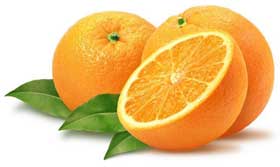 TASTE: Sweet and Bitter, Juicy Sweetness taste, Sweet and Tangy, Slightly sweeter, Sweet with slightly bitterness, Tart, Extra sweet.COLORS: Deep orange color, glossy green to bright yellow skin, pink-grapefruit flesh color.SHAPES: It has a round to oval shape and medium to large size. The round and oblate-shaped seville orange measures from 7 to 8 cm in diameters. Types of oranges have an average size of 6 to 8 cm in diameter and are spherical in shape.
LANGUAGES
OTHER NAMES
English
orange, sweet orange
German
Orange, Apfelsine (north)
Dutch
sinaasappel, appelsien
Swedish
apelsin
Danish
appelsin
Norwegian
appelsin
Icelandic
appelsína
French
oranger / orange, orange douce
Italian
arancio / arancia, arancia dolce
Spanish
naranjo / naranja
Catalan
taronger / taronja (pl. taronges)
Portuguese
laranjeira, laranja
Romanian
portocal, portocalul dulce / portocala
Tamil
Arancu palam
Research indicates that oranges contain high concentrations of vitamin C and bioflavonoids (what we call vitamin P) for effects of coordinating biofunctions; oranges provide a wide range of benefits with great taste; the vitamins and gelatine in the fibers help with gastric digestion and constipation; have some oranges after meals can help rid the greasiness; some oranges after drinking alcohol can also ease the discomfort.
During the recovery period of a sickness, eating some oranges usually help with urinating and getting back on track with normal metabolism. Thus, orange juice is usually a popular choice in wedding banquets or parties. Additionally, orange peels can also be used in tea beverages or baths with in accompany of ginger.

Navel Oranges

Bergamot Oranges

Blood Oranges

Valencia Oranges

Seville Oranges

Cara Cara oranges

Mandarin Oranges

Lima Oranges

Clementine Oranges
 TOP COUNTRIES PRODUCING ORANGES:
In 2019, world production of oranges was 79 million tonnes, led by Brazil with 22% of the total, followed by China, India, the United States, and Mexico as other major producers (table). In the United States, groves are located mainly in Florida, California, and Texas. The majority of California's crop is sold as fresh fruit, whereas Florida's oranges are destined to juice products. The Indian River area of Florida is known for the high quality of its juice, which often is sold fresh in the United States and frequently blended with juice produced in other regions because Indian River trees yield very sweet oranges, but in relatively small quantities. Orange juice is traded internationally as frozen, concentrated orange juice to reduce the volume used so that storage and transportation costs are lower.
Country
Production (millions of tonnes)
 Brazil
17.1
 China
China
10.4
 India
India
9.5
 United States
4.8
 Mexico
4.7
 Spain
Spain
3.2
 Egypt
Egypt
3.2
World
78.7
NUTRITIONAL VALUES:
| Vitamins | Quantity | %DV† |
|---|---|---|
| Vitamin A equiv. | 11 µg | 1% |
| Thiamine (B1) | 0.087 mg | 8% |
| Riboflavin (B2) | 0.04 mg | 3% |
| Niacin (B3) | 0.282 mg | 2% |
| Pantothenic acid (B5) | 0.25 mg | 5% |
| Vitamin B6 | 0.06 mg | 5% |
| Folate (B9) | 30 µg | 8% |
| Choline | 8.4 mg | 2% |
| Vitamin C | 53.2 mg | 64% |
| Vitamin E | 0.18 mg | 1% |
| Vitamin K | 14.6 µg | 2% |
| Minerals | Quantity | %DV† |
|---|---|---|
| Calcium | 40 mg | 4% |
| Iron | 0.1 mg | 1% |
| Magnesium | 10 mg | 3% |
| Manganese | 0.025 mg | 1% |
| Phosphorus | 14 mg | 2% |
| Potassium | 181 mg | 4% |
| Sodium | 2 mg | 0% |
| Zinc | 0.07 mg | 1% |
| Other constituents | Quantity |
| Water | 86.75 g |
COOKING OF ORANGE:
Orange fruit sections are a great addition to green and fruit salads. Orange fruit juice can be a refreshing intra-day drink. It is also used in the preparation of desserts, jams, and jellies. It's zest (peel) also employed in the preparation of popular dishes as a flavoring agent. Dried orange blossoms and leaves can be used in herbal tea.
HOW-TO-BUY-FRESH-ORANGES
California, Florida, Texas, and Arizona produce our year-round supply of oranges. Leading varieties from California and Arizona are the Washington Navel and the Valencia, both characterized by a rich orange skin color. The Navel orange, available from November until early May, has a thicker, somewhat more pebbled skin than the Valencia; the skin is more easily removed by hand, and the segments separate more readily. It is ideally suited for eating as a whole fruit or in segments in salads.
The western Valencia orange, available from late April through October, is excellent either for juicing or for slicing in salads. 17 Florida and Texas orange crops are marketed from early October until late June. Parson Brown and Hamlin are early varieties, while the Pineapple orange — an important, high-quality orange for eating — is available from late November through March. Florida and Texas Valencias are marketed from late March through June.
The Florida Temple orange is available from early December until early March. Somewhat like the California Navel, it peels easily, separates into segments readily, and has excellent flavor. Oranges are required by strict State regulations to be mature before being harvested and shipped out of the producing State. Thus, skin color is not a reliable index of quality, and a greenish cast or green spots do not mean that the orange is immature. Often fully matured oranges will turn greenish (called “regreening”) late in the marketing season.
Some oranges are artificially colored to improve their appearance. This practice has no effect on eating quality, but artificially colored fruits must be labeled “color added.” “Discoloration” is often found on Florida and Texas oranges, but not on California oranges. This is a tan, brown, or blackish mottling or specking over the skin. It has no effect on eating quality, and in fact often occurs on oranges with thin skin and superior eating quality.
Look for: Firm and heavy oranges with fresh, brightlooking skin which is reasonably smooth for the variety.
Avoid: Light-weight oranges, which are likely to lack flesh content and juice. Very rough skin texture indicates abnormally thick skin and less flesh. Dull, dry skin and spongy texture indicate aging and deteriorated eating quality. Also avoid decay — shown by cuts or skin punctures, soft spots on the surface, and discolored, weakened areas of skin around the stem end or button.



|
|

|
|
Whole Fruits |
Apple Fruit |
Tamarind Fruit |
List Of Fruits |
Full List Of Fruits |
Fruits Classification |
Seasonal Fruits |
Seasonal Fruits by Country |
Storage of Fruits |
Fruits Nutrition |
Uses of fruits |
Fruits Carving |
Types of Fruits |
Fruit Articles |
Fruits Gallery |
Fruits Glossary |
Fruits Quiz |
Processed Products Of Fruits | Links |
Tell a Friend |
Blogs Sitemap |
Sitemap |
Fruits Sitemap |
Disclaimer |
Privacy Policy
Copyright Fruitsinfo 2004-2022 - All rights reserved |